 There hasn’t been a literature review on this blog for a while, so it’s time to pick up where I left. Jumping from 1997 in review of Asbjørnslett’s “Assess the vulnerability of your production system” to 2007 in today’s review, I can tell that supply chain research has made a big leap forward. Today’s article presents six propositions that relate the severity of supply chain disruptions to supply chain design characteristics and supply chain mitigation capabilities, illustrating the connections between supply chain risk, vulnerability, resilience, and business continuity planning.
Supply Chain Disruptions
The authors argue that supply chain disruptions and the associated operational and financial costs should be viewed as a normal occurrence. However, there are specific factors that contribute to or dampen the severity of such disruptions. These factors should be taken into consideration when firms make decisions as whether or not enact or implement specific operational policies, practices and initiatives, in order to avoid bolstering contributing factors while at the same time pursuing factors that lessen supply chain disruptions:
Supply Chain Design
– supply chain density
– supply chain complexity
– node criticalitySupply Chain Mitigation Capability
– recovery capability
– warning capability
Based on a three-phase empirical study, employing an in depth a analysis of 1) a single firm with a global supply chain, 2) phone interviews with executives in nine firms and 3) focus groups, the paper distills the following factors as the main contributors related to the impact of supply chain disruptions:
The propositions based on the research are:
- An unplanned event that disrupts a dense supply chain is more likely to be severe than if the supply chain is relatively less dense.
- An unplanned event that disrupts a complex supply chain is more likely to be severe than if the supply chain is less complex.
- An unplanned event disrupting one or more critical nodes of a supply chain is likely to be more severe than if it disrupts less critical nodes
- An unplanned event that disrupts a supply chain with proactive or reactive recovery capabilities is likely to be less severe than without recovery capabilities in place.
- An unplanned event that disrupts a supply chain with the capability to quickly detect and disseminate information about the event is likely to be less severe than when no information is detected or disseminated.
- An unplanned event disrupting a supply chain that is dense, complex and with many critical nodes is less likely to be severe if there is a capability to quickly detect and disseminate information about the event and thus respond and correct in a proactive or reactive manner.
From my point of view, this all makes common sense, although it is nice to see it confirmed empirically.
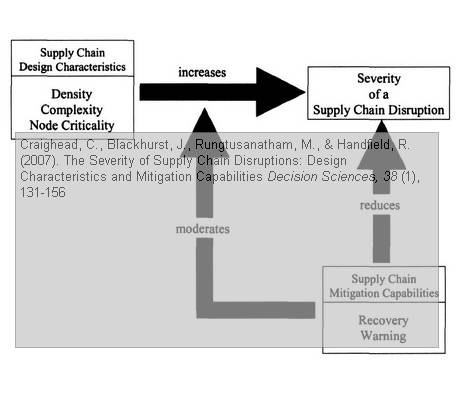
What the paper also suggests is that although ideally all 6 propositions should be in place for a full mitigation impact, either proposition can be used to strengthen only individual parts or the whole of a supply chain.
In conclusion, the paper suggests three possible further research alleys:
- To test and validate the six propositions.
- To investigate the interactions between density, complexity and criticality.
- To examine the dampening effects of different recovery measures.
My opinion: Indeed, a very fruitful paper for further research.
Reference
Craighead, C., Blackhurst, J., Rungtusanatham, M., & Handfield, R. (2007). The Severity of Supply Chain Disruptions: Design Characteristics and Mitigation Capabilities Decision Sciences, 38 (1), 131-156 DOI: 10.1111/j.1540-5915.2007.00151.x
Author links
- utk.edu: Christopher Craighead
- linkedin.com: Jennifer Blackhurst
- researchgate.net: M Rungtusanatham
- supplychainredsign.com: Robert Handfield
Related
- husdal.com: Bad locations – bad logistics?