
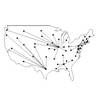
 Classical facility location models assume that once optimally located and set up, facilities will operate as planned, smoothly, and without interruption. In reality, though, operations seldom go as planned; interruptions, unscheduled downtime and failures occur every once in a while, with unplanned and unbudgeted disruption costs as a consequence. Is it possible to know beforehand which locations that have the least disruptions costs?
Trading operation costs against disruptions costs
In Reliability Models for Facility Location: The Expected Failure Cost Case, L.V. Snyder and M. S. Daskin do just that. They present a model that calculates the minimum location cost for multiple facilities, while at the same time minimizing disruption costs. The model generates a trade-off curve between day-to-day operation costs and expected failure costs, showing that substantial reduction in expected failure costs can be achieved with minimal increasing in operation costs.
Methodology
For the more analytically inclined I will just say that the model is based on the classic P-median problem (PMP) and uncapacitated charge location problem UFLP and a Langrangian relaxation algorithm. The model considers the failure costs, given a probablity that each facility will fail and assuming that multiple facilities can fail simultaneously. The model by Snyder and Daskin shows that even a small increase in operation costs and a careful selection of facilities can lead to significant reductions in failure costs.
Practical background
The background for developing the model is that, obviously, very few firms would be willing to choose locating its facilities such that the normal operating costs are higher than optimal, just to hedge against the case of potential disruptions, especially if you don’t know where the disruption will occur or what kind of disruption that will occur.
Theoretical background
The model synthesizes three strands of research: Network reliability, covering problems or models, and supply chain vulnerability and resilience.
More suppliers is not more reliability
Interestingly, what should be remembered in selecting the optimal number of facilities vis-a-vis potential supply chain disruptions, is that adding redundant suppliers does not create more reliability, because it in fact increases the overall probability that one or more suppliers will fail.
The P-median problem (PMP)
The P-median problem minimizes a weighted sum of the operating cost and the expected disruption costs, given a random distribution of facility failures. Certain facilities can be designated as nonfailable and multiple failures can occur at the same time.
The reliability fixed-charge problem (RFLP)
The RFLP forms the basis for the UFLP, in that the RFLP can only minimize costs for a different set of locations, whereas the UFLP can accommodate unlimited facilities, and thus allows for the construction of additional facilities where this is most favorable for the overall solution.
Results
The results show the tradeoff between UFLP costs (operation costs) and expected failure cost, e.g. at an operating cost of $1,000,000 one can expect a failure cost of $400,000. Increasing operating cost to 1,200,000 reduces failure costs to $200,000. The model can also show how many nonfailable facilities that are needed for a certain level of reliability.
Conclusion
The paper makes a convincing argument that facility location can be of critical importance in in reducing the cost of disruptions. The weakness though, as I see it, is that the model assumes added transportation cost as the driving factor, and albeit this probably IS the driving factor other cost elements should also be investigated.
One other weakness, and they point to it themselves, is that all failures have the same probability. The reason for this simplification is that more probabilities exponentially increase the number of terms in the objective function, exponentially increasing the computational work that has to be done. This, they say, will be the object of further studies.
Secondly, the model assumes that all facilities are uncapacitated, which is, in most cases, an unrealistic assumption. Here too, further studies will be made to accommodate capacitated facilities.
Finally the authors note that the tradeoff may not be easily understood, since there is still is an element of uncertainty, since it assumes a certain probability for failure, which may or may not hold true. What matters to decison makers is hard numbers, not maybe numbers. On the other hand, visualizing tradeoff allows for a better understanding of the idea that improving reliability at a small cost can greatly reduce disruption costs.
Reference
Snyder, L., & Daskin, M. (2005). Reliability Models for Facility Location: The Expected Failure Cost Case Transportation Science, 39 (3), 400-416 DOI: 10.1287/trsc.1040.0107
Author links
- lehigh.edu: Lawrence V Snyder
- umich.edu: Mark S Daskin
Related
- husdal.com: Bad locations – bad logistics