 In my post two days ago, reviewing the article by Manuj and Mentzer (2008) titled Global Supply Chain Risk Management, I mentioned that they cited a paper by Ghoshal (1987) titled Global Strategy: An Organizing Framework as one of their references for listing risk management strategies. Today, I will take a closer look at that paper. The word “supply chain” doesn’t even appear once in Ghoshal’s paper, but why is this paper so interesting in a supply chain risk perspective?
Global strategy
The paper was written at the onset of globalization in 1987, when the buzzword of the day, “global strategy”, was still an emerging, but already very popular concept among managers of multinational corporations. One of the driving forces in any company is the desire to gain competitive advantage over its competitors. “Going global” is (or in 1987 still “was”) one of the means to achieve this. Today, it’s hard to imagine any corporation not being multinational in one way or the the other, or having at least some parts of its supply chain stretched around some parts of the globe. In his paper, Ghoshal provided a framework for selecting appropriate strategies when going global, and risk management was one of the strategies he looked at.
Competitive advantage – means and ends
In a multinational or global setting, competitive advantage can be gained from three sources (means): 1) Exploiting national differences in the countries the company is involved in, 2) Benefiting from economies of scale, and 3) Exploiting synergies from economies of scope, created by the diversification of its activities. The strategic task of managing globally is to use these three sources to achieve these three strategic objectives (ends): 1) Efficiency in current operations, 2) Risk management, and 3) Innovation, learning and adaptation. In the following I will deal with managing risks only.
Managing risks
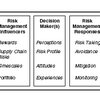
A multinational corporation faces many risks, some of which are endemic to all firms, and others which are unique to organizations operating across national boundaries. Ghoshal (1987) divides the risk into four broad categories, the same four categories that 20 years later are picked up by Manuj and Mentzer (2008).
Macroeconomic risks
– random movements in the economic environment (wages, interest rates, exchange rates, commodity prices)Political risks
– policy actions from national governments (legal and regulatory actions, nationalization, war)Competitive risks
– uncertainty about competitors actions or development of competitive technologyResource risks
– lack of human resources, technology or capital
One important issue with risks is that they change over time, and the strategic task is to consider these risks jointly in the context of particular strategic decisions. It is the risks that cannot be diversified in a global environment that should be of most concern. If you’re interested in political risk in particular, I suggest you read my review of the Gower Short Business Guide on Political Risk.
Conclusion
It is interesting to note that a paper written more than 20 years ago still holds true today and still provides ample inspiration for today’s research. The reason for this may be that Ghoshal managed to synthesize the existing ideas and techniques of his time. Since then, globalization has taken many steps forward, but some aspects of globalization, like the framework in this paper, will definitely stand the test of time.
Reference
Ghoshal, S. (1987). Global Strategy: An Organizing Framework Strategic Management Journal, 8 (5), 425-440
Author links
- wikipedia: Sumantra Ghoshal
Related
- husdal.com: Global Supply Chain Risk Management
- husdal.com: Book Review: Handbook of Global Supply Chain Management