 I’ve been travelling this week, which is why there haven’t been any posts for a while, and on my trip I experienced first hand the latest innovation in aviation logistics: Point Merge when approaching the destination airport. Aviation logistics is perhaps the wrong term as it is more correct to say the latest innovation in air traffic control, namely the sequencing of incoming and outgoing aircraft. Oslo airport in Norway was the first in the world to try out this new system, of course on the very day I was travelling. Apart from causing a great deal of delays and cancellations (and passenger frustrations) due to heavy restrictions on the number of aircraft movements allowed during the initial phases of this new system I can’t help but think about how nice it would be if all logistics or supply chain management issues were this easy to solve, at least on paper.
Point Merge
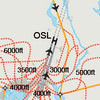
The best way to illustrate Point Merge is to use these figures I found on the Avinor (Norwegian Aviation Authority) website. This is how the approach paths to Oslo airport (OSL) look like in a normal situation:
This is how the are supposed to look like with Point Merge in place:
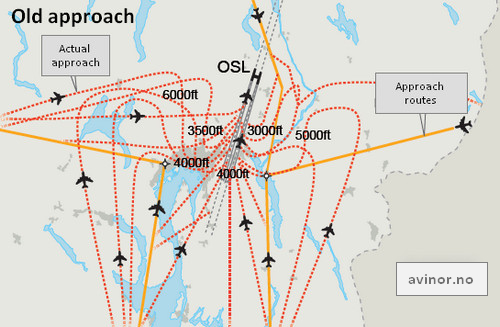
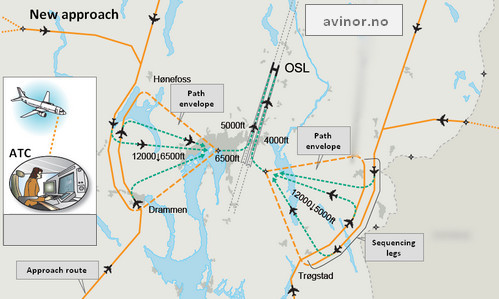
I does look much better, and it makes me wonder why they haven’t done this all along. The idea is that the planes line up along a sequencing leg, where they at the right moment (to keep the aircraft separated) are told by air traffic control to turn into the path envelope, where they continue towards Point Merge, from where the final approach is flown. This way, so the system promises, aircraft not only make orderly directed turns towards the airport, but can also descend in a continuous manner towards the airport, not stepwise as was the case before, thus saving fuel, time and money.
Just-in-Time
Coming to think of it, is Point Merge really that revolutionary? Or is is just putting Just-in-Time to practice? Effectively, to me, that’s what it is.
Related links
- eurocontrol.int: Point Merge
- avinor.no: Point Merge (in Norwegian only, but nice graphics)
Related posts
- husdal.com: Happy Holidelays!
- husdal.com: A-maze-ing discoveries