
 In a previous post, a while I ago, I stated that Nowegian roads are dangerous…well, not only that, they are among the slowest in Europe, according to a newspaper article in Dagbladet. Comparing average speed on roads in 13 countries, it turns out that travelling in central Europe is several times much faster than in Norway.
The comparison
If you compare the travel time between two major cities in Norway, say, Oslo and Stavanger and two equally distant cities in Portugal, say Porto and Faro, located about 558 km and 556 km from each other, it takes almost 3 hours more to cross this distance in Norway. Why?
More roads
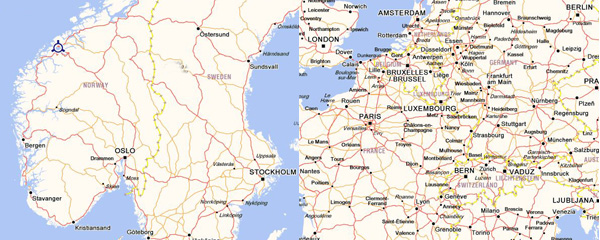
One issue is that central Europe of course has a much denser road network, forcing more traffic on to the same roads, while a European traveler can chose between many possible routes, without deviating too much from the intended direction. That is not possible in Norway. But that is not the only reason.
More motorways
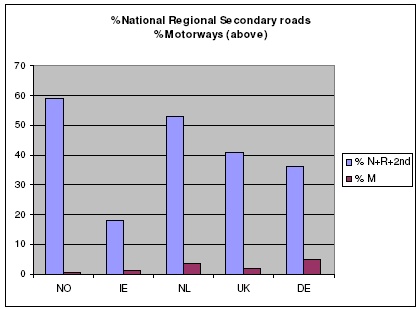
Norway has very fem kilometers of motorways compared to the rest of Europe. Besides that, the speed limit in Norway is 80 km/h (50 mph), and usually 90 km/h on most (of the few) motorways. No wonder that traveling in Norway requires a good dose of patience. But that too is not the only reason why things are moving so slowly in Norway.
Better roads
Norwegian roads are sub-standard compared to much of Europe. Anyone who has ever been to Norway will agree.It has it’s charm for the tourist who is not in a rush, but business travelers, freight forwarders and truckers pay the price. Delays and disruptions are common. I could blame it on the topography and the fact that road construction is indeed expensive in Norway. But maybe it is because infrastructure is seen as a cost rather than an investment with a return potential?
Depressing
This is the average speed (km/h) for traveling between major cities in European countries:
- France 110,3
- Germany 109,0
- Portugal 98,8
- Austria 98,3
- Denmark 97,3
- UK 96,0
- Switzerland 91,8
- Sweden 88,1
- Finland 78,4
- Ireland 74,4
- Poland 71,9
- Norway 68,2
- Albania 65,5