 If you are into network analysis of any kind, this book teaches you the basics. As the name implies, Networks and Algorithms by Alan Dolan is an introductory book. It tells you the difference between the various forms and types of graphs, trees and networks and shows you step by step calculations on how to solve them by hand (they didn’t have that many computers in 1993). It doesn’t get any better than that, if you want to learn the core science of algorithms.
Step by step
If you’re a programming wiz, you can get your own algorithm running in no time. It’s also step-by step illustrated, so you cannot go wrong. It also contains exercises and solutions. Solid!
Do it by hand
As mentioned above, in 1993, computing power was still in its infancy, and least cost path algorithms were still worked out by hand.
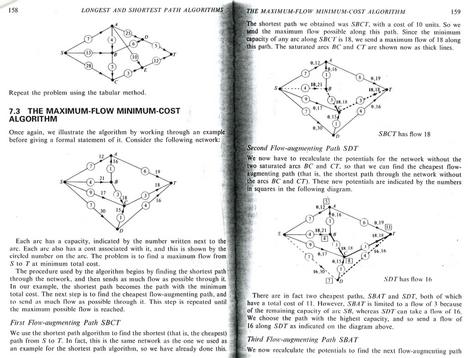
That is why the book comes with a large number of examples, fully illustrated and step by step iterative calculations. This is the way to learn algorithms…and how to program them.
Reference
Dolan, A. and Aldous, J. (1993) Introduction to Networks and Algorithms. London: Wiley & Sons
amazon
- amazon.com: Networks and Algorithms
Related
- husdal.com: Shortest path computation