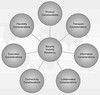
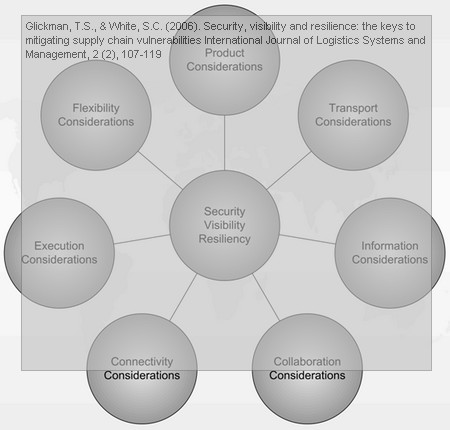
 The numerous possibilities of disruptions and disturbances in the supply chain demand a supply chain that is responsive to a variety of threats. A non-responsive and hence unreliable supply chain is by definition a vulnerable supply chain, and the keys or tools to mitigating supply chain vulnerability are security, visibility and resilience. So said Theodore Glickman and Susan White in 2006, when they published Security, visibility and resilience: the keys to mitigating supply chain vulnerabilities. Here they present a framework for how these three tools interact with seven basic supply chain concerns, and combined make up 21 considerations for improving supply chain reliability.
Three tools for mitigating supply chain vulnerabilities
Supply Chain Risk Management is the art of reducing the likelihood of disruptions when and where possible and increasing the number of options to respond to disturbances when they do happen. This clearly acknowledges that both mitigation and contingency strategies must be sought. In this light, the authors say, there are three fundamental keys to mitigating supply chain risk: security, visibility, and resiliency:
Security is a preventative tool–security seeks to minimize the likelihood of disruptions. Visibility is an intervention tool–visibility throughout the supply chain allows managers the opportunity to respond quickly to disruptions based on accurate, real-time assessment. Finally, resiliency ensures continuity–resiliency is the ability to return the supply chain to an operational level shortly after disruptions have occurred.
Each of the keys can be linked to seven basic supply chain concerns: product, transport, information, collaboration, connectivity, execution, and flexibility.
Seven areas of concern
The seven areas of concern are partly taken from Visibility: Tactical Solutions, Strategic Implications, a 2002 Report on Trends and Issues in Logistics and Transportation:
The full report can be downloaded below, and is a very interesting and highly recommended read on its own.
21 considerations
Combing the three tools and theseven areas of concern, 21 considerations emerge:
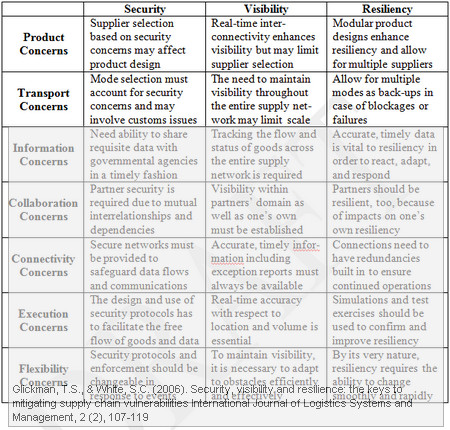
Security: Prevention. Proactive steps throughout the supply chain ensure security and earliest possible risk mitigation. Supply chain security concerns include many facets from supplier selection to transport mode management to connectivity and collaboration.
Visibility: Intervention. When disruptions occur, whether due to breakdowns in security or to events beyond the control of the supply chain partners, visibility throughout the supply chain is the key to effective, timely efforts to intervene and minimize the adverse effects of the disruptions.
Resiliency: Continuity. Starting already at the product design stage, resiliency ensures that the entire supply chain responds accordingly 0nce intervention has addressed the immediate concerns of the supply chain disruption.
Critique
Many journal articles written in the early post 9/11 era focus very much on terrorism, security and large-scale threats causing massive disruptions. This paper is no exception. Personally I am more inclined to consider smaller events as initiators of large-scale consequences, if not handled appropriately, as in the Ericsson-Nokia plant fire. That said, what I do like about this paper is the combination of the three tools and the seven areas of concern that (to my knowledge) manages to fully capture the entire supply chain in and out. While it could perhaps do with a little more refinement, it is one of the better frameworks for mitigating supply chain vulnerabilities that I have come across.
Related topics
The curious reader will notice that this article has taken many ideas from Rice and Caniato (2006), who in Building a secure and resilient supply chain link flexibility and redundancy with security and resilience. Sheffi’s book on The Resilient Enterprise has also provided much inspiration to this article. For readers wanting to know more about the topic of resilience, Ken Simpson’s Contemplating… blog is well worth many visits.
Reference
Glickman, T.S., & White, S.C. (2006). Security, visibility and resilience: the keys to mitigating supply chain vulnerabilities International Journal of Logistics Systems and Management, 2 (2), 107-119 : 10.1504/IJLSM.2006.009554
Author links
- gwu.edu: Theodore Glickman
- Susan White
Download
- Draft: Security, visibility and resilience
- georgiasouthern.edu: Visibility