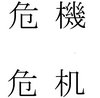
 Time to debunk one of biggest and most persistent myths that has plagued crisis management for more than sixty years, namely the Chinese sign for crisis. Contrary to popular belief in the West, it does NOT mean opportunity. Many will probably have heard that When written in Chinese the word crisis is composed of two characters. One represents danger, and the other represents opportunity. That is not true. While many linguists know that this is wrong, the myth has persisted to this day and will probably still persist in the future. Why? Because a crisis in fact can be interpreted as an opportunity. But it is not an opportunity because the Chinese thought or wrote so.
The myth
I have always enjoyed this way of thinking about a crisis: an opportunity to look at a situation with new eyes, a chance for improvement and change, lessons to be learned. That is all true, perhaps, but it’s got nothing to do with the Chinese. It’s all in our own head, so it seems, because the other day I came across a post on pinyin.info that explains how this myth came about and what the Chinese word for crisis really means. Here Victor H. Mair, Professor of Chinese Language and Literature at the University of Pennsylvania writes that
Like most Mandarin words, that for “crisis” (wēijī) consists of two syllables that are written with two separate characters, wēi (危) and jī (機/机). While it is true that wēijī does indeed mean “crisis” and that the wēi syllable of wēijī does convey the notion of “danger,” the jī syllable of wēijī most definitely does not signify “opportunity.” The jī of wēijī, in fact, means something like “incipient moment; crucial point (when something begins or changes).” Thus, a wēijī is indeed a genuine crisis, a dangerous moment, a time when things start to go awry. A wēijī indicates a perilous situation when one should be especially wary. It is not a juncture when one goes looking for advantages and benefits. In a crisis, one wants above all to save one’s skin and neck!
The truth
So, a crisis in Chinese isn’t any different from a crisis in English, or any other language for that matter. A crisis is the result of signs not seen and warnings not heeded, as I wrote earlier this week. While I haven’t checked it, I wouldn’t be surprised if I found this misinterpretation of wēijī even in the Harvard Business Review on Crisis Management.
If one wishes to wax philosophical about the jī of wēijī, one might elaborate upon it as the dynamic of a situation’s unfolding, when many elements are at play. In this sense, jī is neutral. This jī can either turn out for better or for worse, but — when coupled with wēi — the possibility of a highly undesirable outcome (whether in life, disease, finance, or war) is uppermost in the mind of the person who invokes this potent term.
The misunderstanding
In this sense the jī is perhaps more linked to risk and uncertainty than opportunity, and in conclusion I can only agree with Hair when he writes that
Those who purvey the doctrine that the Chinese word for “crisis” is composed of elements meaning “danger” and “opportunity” are engaging in a type of muddled thinking that is a danger to society, for it lulls people into welcoming crises as unstable situations from which they can benefit. Adopting a feel-good attitude toward adversity may not be the most rational, realistic approach to its solution.
Confirmation?
Have we been wrong all these years, ever since John F. Kennedy used it in a speech in Indianapolis on 12 April 12 1959? Sixty years of wrong beliefs? Considering that I do have a fair number of Chinese readers, I invite you to comment below and confirm that Danger + Opportunity ≠ Crisis.
Link
- pinyin.info: Danger + Opportunity ≠ Crisis