 In our interconnected world, safety, reliability and efficiency can only be secured through collaboration between industries and government. This is the theme of a recently published report titled New Models for Addressing Supply Chain and Transport Risk. Written in collaboration with Accenture and published as an initiative of the Risk Response Network with the World Economic Forum, the report highlights the urgent need to review risk management practices to keep pace with rapidly changing contingencies facing the supply chain, transport, aviation and travel sectors.
The WEF Risk Response Network
My regular readers may remember a post from last year where I reported on the Supply Chain and Transport Risk Initiative that is part of the Risk Response Network within the World Economic Forum. The Risk Response Network (RRN) was launched in Davos in January 2011 to bring together the world’s experts in managing risk from all sectors of society. Now, a year later, they have published their first full report and supply chain and transport risk.
Private and public must cooperate
Global supply chains and transport networks form the backbone of the global economy, fuelling trade, consumption and economic growth. This interconnectedness has an unquestionable upside: growth, cooperation and prosperity, but it also has a downside: risks and localized events in one part of the chain or network are no longer confined to just that part of the network, but can cascade through the entire network with potentially devastating consequences worldwide. Supply Chain Risk Managment is thus no longer just a private matter of the enterprises involved in supplying and transporting goods, but governments too have also been increasingly challenged to understand and manage risk across global supply chain and transport networks, so the report says.
Supply chain disruptors
The report points to these five as the top external disruptors:
- Natural disasters
- Conflict and political unrest
- Sudden demand shocks
- Export/import restrictions
- Terrorism
I find it interesting to see conflict and political unrest this far up on the list, but last year’s events and the Middle East, let alone the political and fiscal crisis in the Eurozone is reason enough to make this a number two reason for supply chain disruptions.
The full list can be seen in the figure below:
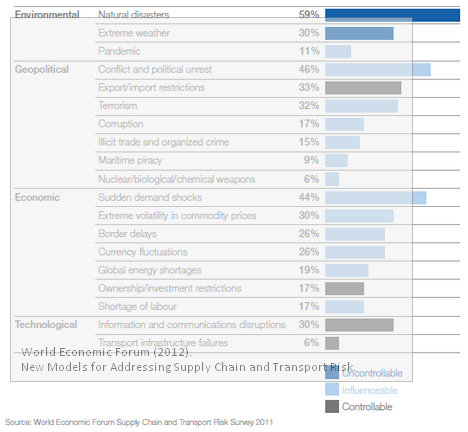
Note the differentiation in uncontrollable, influenceable and controllable risk.
Supply chain vulnerabilities
According to the report, these five are the top vulnerabilities:
- Reliance on oil
- (Non-)Avalability of shared data/information
- Fragmentation along the supply chain
- Extensive subcontracting
- Supplier visibility
Again, a surprise, as I have never thought of reliance on oil as a supply chain reliability, but the report states that
Reliance on oil was identified as the greatest vulnerability and an immediate change in oil availability as a result of external disruptions such as civil unrest, terrorist attacks, strikes or export restrictions could have an extensive global impact on supply chain and transport networks.
True. That is a major point that is easily forgotten.
The full list can be seen in the list below:
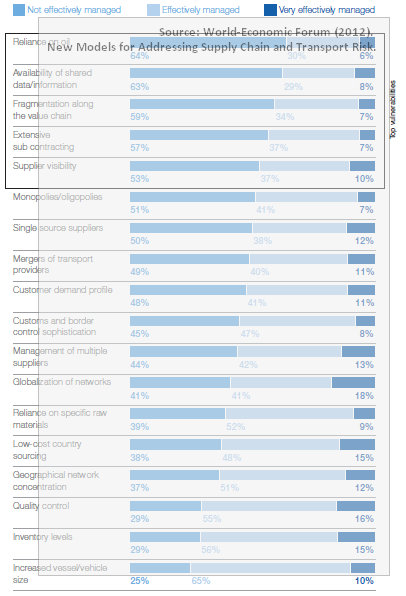
Again, note the differentiation, i.e. how the respondents view the risks.
Recommendations
Besides highlighting how these risks can be mitigated and managed, the report alsoputs foward five recommendations for businesses and governments:
Government:
- Improve international and interagency compatibility of resilience standards and programmes
Business:
- More explicitly assess supply chain and transport risks as part of procurement, management and governance processes
Joint government and business:
- Develop trusted networks of suppliers, customers, competitors and government focused on risk management
- Improve network risk visibility, through two-way information sharing and collaborative development of standardized risk assessment and quantification tools
- Improve pre- and post-event communication on systemic disruptions and balance security and facilitation to bring a more balanced public and private sector discussion
I think the three last are the most important recommendations, because interconnected supply chains with interconnected risks demand an interconnected response. To me, that is the most important lesson from reading this report.
Related link:
- weforum.org: Supply Chain and Transport Risk