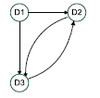
While I know that Graph Theory has many applications, I never expected to see it in Supply Chain Management.

While I know that Graph Theory has many applications, I never expected to see it in Supply Chain Management.
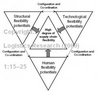
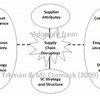
What fascinates me with this paper are (1) the parameters defining supply chain flexibility: Transparency, Simplicity, Responsiveness/Agility and Security/Reliability, and (2) flexibility potentials: Structural, Technological and Human flexibility potentials.
What is supply chain risk in turbulent environments really…simply old wine in new bottles or something profoundly new?
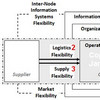
What do you do when you find two research papers by the same three authors, published the same year, in two different journals, with almost the same title?

This is the first paper that sparked my research interest in transportation vulnerability, and what would later become the focus area of my research: the cost of transportation vulnerability and the benefit of transportation reliability.
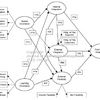
How does company culture shape a firm’s risk mitigation and response, and thus, how does company culture shape a firm’s supply chain agility?
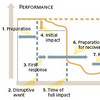
Building a resilient enterprise is an enterprise-wide undertaking that is about so much more than simply preparing a company for disruptions.
Apparently there must be something really special about Paul Kleindorfer. Otherwise there would be no reason for Morris A Cohen and Howard Kunreuther to write their tribute to him.
Finding the right facility location is difficult enough. Keeping it safe is even more difficult. One of the building bricks of the this article is the identification of so-called key supply chain locations.
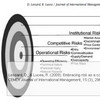
Blindly minimizing risk is a losing proposition in the long term, and uncertainty or risk are at the root of opportunity towards new profitable enterprises. Risk minimizing does not equal profit maximizing.
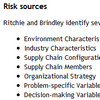
There can be no generally valid risk for all types of supply chains, but risks must be defined from within the context of the supply chain that is the subject of analysis.
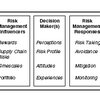
Each individual supply chain is unique in certain respects and this uniqueness may require unique approaches to the management of the risks involved.
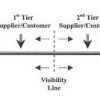
In this study, Svensson investigates the areas, the causes and the contingency planning of corporate vulnerability in upstream and downstream supply chains.Corporate vulnerability in supply chains stems from time dependence, functional dependence and relational dependence.
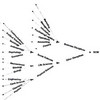
Supply Chain Management needs a new way to pursue research, a new way that is focused on theory building based on learned borrowing from other disciplines. That is how academians can breathe new life into the study of supply chain management.

Someone had to come up with this, it was just a matter of time, and it is no suprise that this article comes from India, one of the major providers of global outsourcing for many industries.
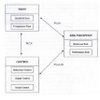
Risk perception and risk management are important subjects in management and strategy studies. Alliances are inherently a risky strategy, since the failure rate of alliances is higher than that of a single firm.

‘All firms are snakes’. So says Paul D. Cousins in A conceptual model for managing long-term inter-organisational relationships, published in 2002. ‘They are maximisers and satisfiers concerned with their own survival and self-interest’.
What is in the supply chain is determined by a design process, and consequently, is it possible to design supply chain risk out of (or in to) the supply chain?

How many ways are there for defining vulnerability and criticality, really? Traditionally, risk matrixes have a likelihood/impact approach, but not always. Yesterday, I was examining a criticality/vulnerability matrix.
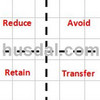
Avoid, Reduce, Transfer and Retain or Accept are the classic four ways of dealing with risk in a risk matrix. However, there are two more: Exploit and Ignore.